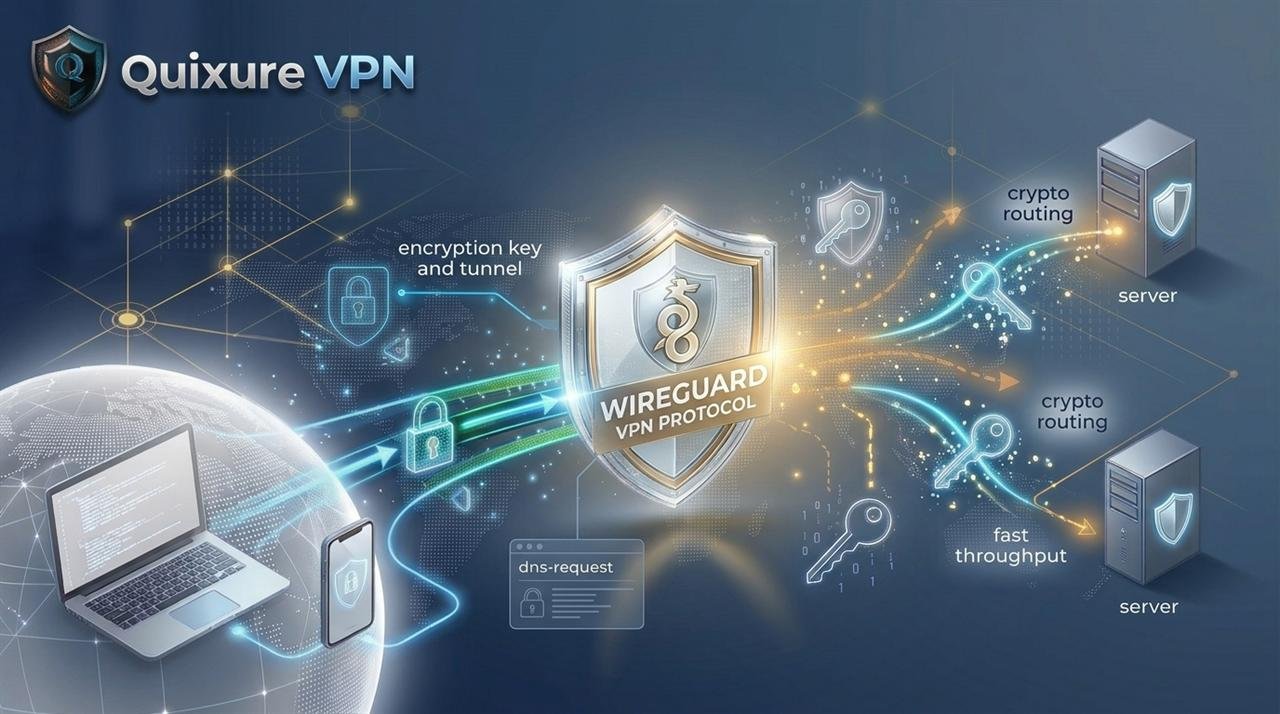
WireGuard shows up in the feature list of almost every modern VPN, including Quixure VPN, but it's rarely explained beyond the name being dropped next to "fast" and "secure." WireGuard is a specific, well-documented piece of engineering — not a marketing term — and understanding what it actually does makes it a lot easier to judge what a VPN built on it can and can't promise you.
What Is WireGuard?
WireGuard is an open-source VPN protocol — the set of rules that defines how a secure, encrypted tunnel gets established and maintained between your device and a server. It's not a VPN service itself; you can't "use WireGuard" the way you use a VPN app, because WireGuard on its own doesn't come with servers, apps, accounts, or a company running any of it. A VPN provider builds its app and server infrastructure around a protocol like WireGuard — the protocol defines the tunnel mechanics, the provider decides everything around it, like server locations, no-logs policy, and app design. Quixure VPN is one such provider that runs on WireGuard.
How Does WireGuard Work?
WireGuard was designed with a specific goal: do one job — secure point-to-point tunneling — and do it with as little code as possible. Its reference Linux implementation has been described by its own authors as notably compact, in contrast with the much larger codebases of older protocols like OpenVPN or IPsec. A smaller codebase can make parts of an implementation easier to review and reason about, though code size alone doesn't prove a protocol is secure — WireGuard's actual review record (covered below) is what matters more. Mechanically, it establishes a tunnel using public-key cryptography (each device has a key pair), performs a fast handshake to set up a session, and then encrypts all traffic through that session with a fixed, modern set of cryptographic primitives — no runtime negotiation of which cipher to use, which removes a category of complexity (and potential misconfiguration) that older protocols carry.
What Encryption Does WireGuard Use?
Unlike older protocols that let an administrator choose from a menu of ciphers, WireGuard's specification fixes one set of modern, well-regarded cryptographic primitives for everyone:
- ChaCha20-Poly1305 for symmetric encryption and authentication of the actual traffic.
- Curve25519 for the elliptic-curve Diffie-Hellman key exchange that establishes a shared secret between devices.
- BLAKE2s for hashing.
- HKDF for deriving session keys from that shared secret.
If you've read our AES-256 encryption guide, this is the same ChaCha20-Poly1305 cipher discussed there as AES-256's main alternative — it's not a weaker substitute, just a different (and, for WireGuard's design goals, deliberately chosen) authenticated cipher. Fixing the cipher suite like this is itself a security decision: there's no "downgrade attack" surface from negotiating a weaker cipher, because there's nothing to negotiate.
WireGuard vs Traditional VPN Protocols
Compared to the protocols WireGuard was designed to replace:
- OpenVPN — highly configurable and widely trusted, but its flexibility (choice of ciphers, TLS-based handshake, larger codebase) means more surface area to configure correctly and to audit.
- IPsec/IKEv2 — mature and well-supported at the OS level, but considerably more complex to implement correctly, with a long history of configuration-related vulnerabilities across different vendors' implementations.
- L2TP/IPsec and PPTP — older protocols still seen in some settings; PPTP in particular is considered obsolete and insecure by modern standards.
WireGuard's main practical edge is simplicity: a smaller, more auditable codebase, a fixed modern cipher suite, and a leaner handshake — which tends to translate into both easier security review and lower overhead in everyday use.
Is WireGuard Secure?
By the standards cryptographers actually use to evaluate protocols, yes — WireGuard has been subject to formal, machine-verified security analysis (including a published formal verification using the Tamarin prover), and its design has been scrutinized by the broader cryptography and Linux kernel communities since its public release. It's worth being precise here rather than making a blanket claim: "secure" describes the protocol design, which has held up well under public review. How secure any specific VPN connection is in practice also depends on how the provider implements and operates it — key handling, server security, and logging practices sit outside what the protocol itself can guarantee.
WireGuard Speed and Performance
WireGuard is generally fast, for reasons that follow directly from its design: a lean codebase, a modern cipher that's efficient on today's hardware, and a simpler handshake than older protocols. That said, it isn't correct to call it the fastest option in every single situation — actual throughput on any VPN connection depends heavily on server load, distance to the server, your own network conditions, and the specific implementation a provider has built. What WireGuard's design reliably delivers is low overhead relative to older protocols, which is why Quixure VPN pairs it with high-capacity 10Gbps servers rather than relying on the protocol alone to carry performance.
Does WireGuard Protect Your Privacy?
This is where it's worth separating the protocol from the provider. WireGuard's tunnel encryption protects the content of your traffic in transit, the same fundamentals covered in our guide to how a VPN works. But WireGuard as a protocol doesn't define a provider's logging policy — whether connection timestamps, IP assignments, or activity get written to disk is entirely a decision made by whoever operates the servers, not something the protocol itself enforces. That's exactly why a provider's no-logs policy, kill switch, and DNS leak protection matter as separate things to check — see our guides to kill switches and DNS leak protection for the gaps WireGuard's encryption alone doesn't close.
How Quixure VPN Uses WireGuard
Quixure VPN runs on the WireGuard protocol, paired with an automatic kill switch and DNS leak protection on every connection, so the tunnel itself and the gaps around it (a dropped connection, a leaking DNS lookup) are both covered rather than just the encryption in isolation. That runs across 10Gbps servers in 25+ countries. Quixure states that it operates under an independently audited zero-log policy and uses RAM-only infrastructure — provider-level privacy practices that are separate from, and not guaranteed by, WireGuard's protocol design itself. A single subscription covers unlimited simultaneous connections across Windows, Mac, iOS, Android, iPad, Linux, and the browser extension.
A Modern Protocol, Backed by a No-Logs Policy
Quixure VPN runs on WireGuard with an automatic kill switch and DNS leak protection built in — on 10Gbps servers, under an independently audited zero-log policy.
WireGuard earned its place in modern VPNs the unglamorous way — a small, reviewable codebase and a fixed set of well-regarded cryptographic choices, rather than a marketing claim. The protocol handles the tunnel; everything else about how private and secure your connection actually is comes down to the provider running it. You can download Quixure VPN in under a minute, or compare plans first.