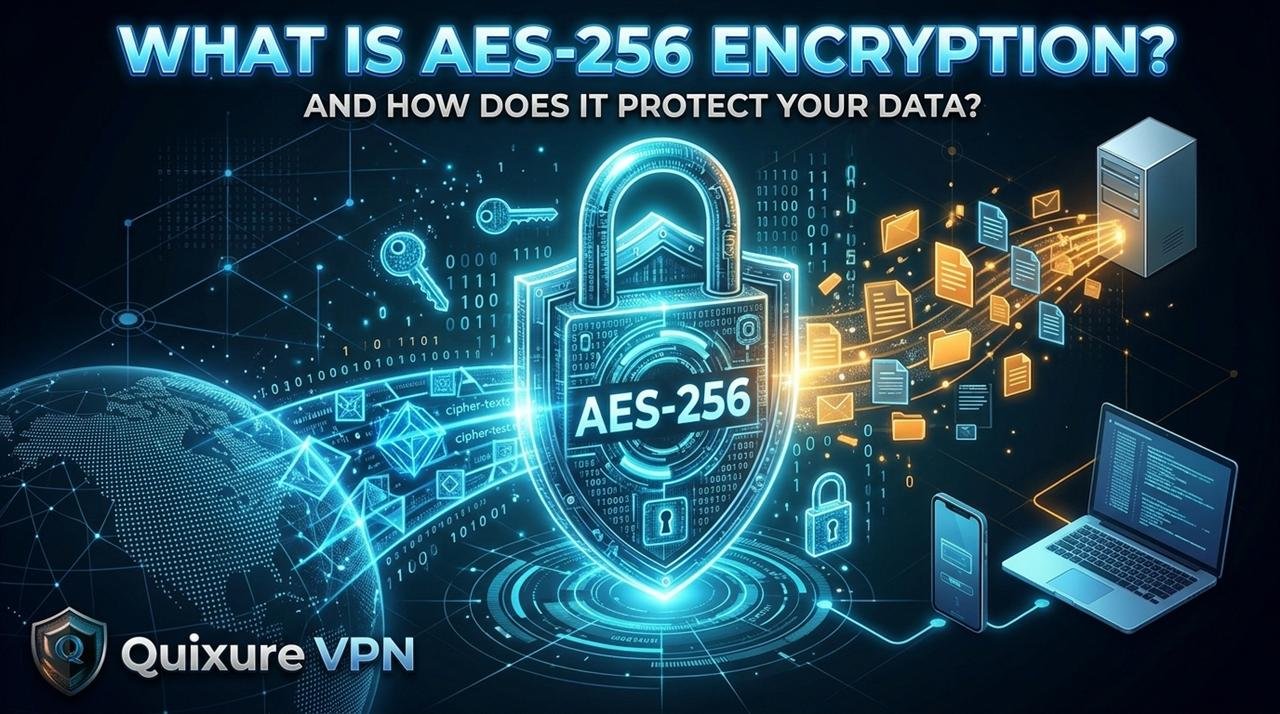
"Military-grade encryption" shows up in a lot of security marketing, and it almost always refers to the same thing: AES-256. It's the encryption standard behind banking systems, government classified data, and VPNs like Quixure. But the phrase alone doesn't explain what AES-256 actually does, or why it's trusted as widely as it is.
What Is AES-256 Encryption?
AES stands for Advanced Encryption Standard — a symmetric-key block cipher adopted by the U.S. National Institute of Standards and Technology (NIST) in 2001 after a multi-year public evaluation process, replacing the older DES standard. "Symmetric" means the same key is used to both encrypt and decrypt data. The "256" refers to the size of that key: 256 bits. AES also comes in 128-bit and 192-bit key variants, but 256-bit is the strongest of the three, and the one most associated with high-security use.
How Does AES-256 Actually Work?
AES is a block cipher, meaning it encrypts data in fixed-size chunks — 128 bits at a time — rather than one bit or byte at a time. Each block goes through multiple rounds of transformation (14 rounds for AES-256, compared to 10 for AES-128), involving substitution, shuffling, and mixing steps that scramble the data in a way that's only reversible with the correct key. You don't need to follow the math to trust the outcome: it's been public, peer-reviewed, and attacked by cryptographers for over two decades without a practical break being found in the cipher itself.
What Does "256-bit" Actually Mean?
The 256-bit key size defines how many possible keys exist: 2²⁵⁶ of them — a number large enough that it's not practically meaningful to compare to anything everyday. Guessing a key by brute force, trying every possible combination, isn't considered feasible with current or realistically foreseeable computing power. That's why AES-256 is treated as the ceiling for symmetric encryption strength rather than something providers upgrade beyond — the quantum computing angle specifically is worth its own section, covered below.
AES-256-CBC vs AES-256-GCM: Why the Mode Matters
AES itself defines how a single block is encrypted, but it needs a "mode of operation" to handle real data made of many blocks — and the mode matters as much as the cipher. Older modes like CBC (Cipher Block Chaining) provide confidentiality — scrambling the data — but nothing else. GCM (Galois/Counter Mode) does both: it encrypts the data and generates an authentication tag that lets the receiving end verify the data wasn't altered or tampered with in transit. That authentication piece is why GCM is generally preferred for securing live traffic, like a VPN connection, over older modes that only handle encryption.
Why Nonce Management Matters in AES-256-GCM
GCM's authentication guarantee depends on one rule being followed correctly: a nonce (a number used exactly once per encryption operation under a given key) must never be reused with that same key. Reuse a nonce in GCM and the damage isn't minor — it can let an attacker recover the authentication key and forge data, undermining both confidentiality and integrity for traffic encrypted under it. This isn't something you manage as a user; it's an implementation detail for whoever builds the encryption layer. But it's a good example of what "AES-256 is secure" actually depends on — the cipher itself, plus getting details like this right every time.
AES-256 vs ChaCha20: What's the Difference?
AES-256 isn't the only authenticated cipher in wide use. ChaCha20 — usually paired with Poly1305 for authentication, as ChaCha20-Poly1305 — is the other major option, and it's the cipher the WireGuard protocol specifies by default. Both are considered secure, with no practical break known in either. The real-world difference is mostly about performance characteristics: AES benefits from dedicated hardware acceleration (AES-NI) built into most modern CPUs, making it extremely fast where that hardware is present, while ChaCha20 was designed to run fast in software alone, without needing special hardware — part of why it suits mobile and embedded devices well. Neither cipher is meaningfully "stronger" in a way that matters in practice; the choice is more about the environment it's running on.
Can Quantum Computers Break AES-256?
Quantum computing comes up a lot in encryption discussions, so it's worth separating the real risk from the speculation. The relevant known algorithm, Grover's algorithm, would give a sufficiently powerful quantum computer a theoretical quadratic speedup on brute-force key search — which, for AES-256, would reduce its effective brute-force security to roughly the equivalent of a 128-bit key. That's still considered infeasible to brute-force with any computer, classical or quantum, that exists today or is realistically on the horizon. AES-256 having a larger key than AES-128 partly exists to preserve that margin, which is why it's the variant specified for long-term and classified-data use.
Is AES-256 Encryption Breakable?
No publicly known practical attack breaks AES-256 itself — every realistic weakness in an AES-256 system traces back to something around the cipher, not the cipher's math. That means a weak or reused key, a flawed implementation, a compromised endpoint, or a server that logs data before it's ever encrypted. This is exactly why a VPN's no-logs policy and server architecture matter as much as its choice of cipher: strong encryption protecting a system that writes logs anyway only protects part of the picture.
How Quixure VPN Uses AES-256 Encryption
Every connection on Quixure VPN runs over AES-256-GCM encryption paired with the WireGuard protocol, combined with an automatic kill switch and DNS leak protection so nothing slips outside the encrypted tunnel. That's backed by an independently audited zero-log policy and RAM-only server infrastructure — so there's no browsing activity sitting on disk to protect in the first place. It all runs on 10Gbps servers in 25+ countries, with a single subscription covering unlimited simultaneous connections across Windows, Mac, iOS, Android, iPad, Linux, and the browser extension. The same encryption applies whether you're securing a connection on public Wi-Fi or deciding between a VPN and a proxy — if you want the fuller picture of how it all fits together, see our guide to how a VPN works.
AES-256-GCM Encryption, On Every Connection
Quixure VPN pairs AES-256-GCM with WireGuard, a kill switch, and DNS leak protection — the same encryption standard trusted by banks and governments, running on infrastructure that keeps no logs to begin with.
AES-256 is doing exactly what it was designed to do: make the encrypted data itself a dead end for anyone without the key. The parts worth paying attention to are the ones around it — the mode it runs in, how keys are handled, and whether the provider is logging anything in the first place. You can download Quixure VPN in under a minute, or compare plans first.