VPNs and proxies get mentioned in the same breath a lot — both can change the IP address a website sees, and both can get around simple geo-restrictions. That's roughly where the similarity ends. What they do with your traffic underneath is very different, and that difference is usually what matters.
What Is a Proxy Server?
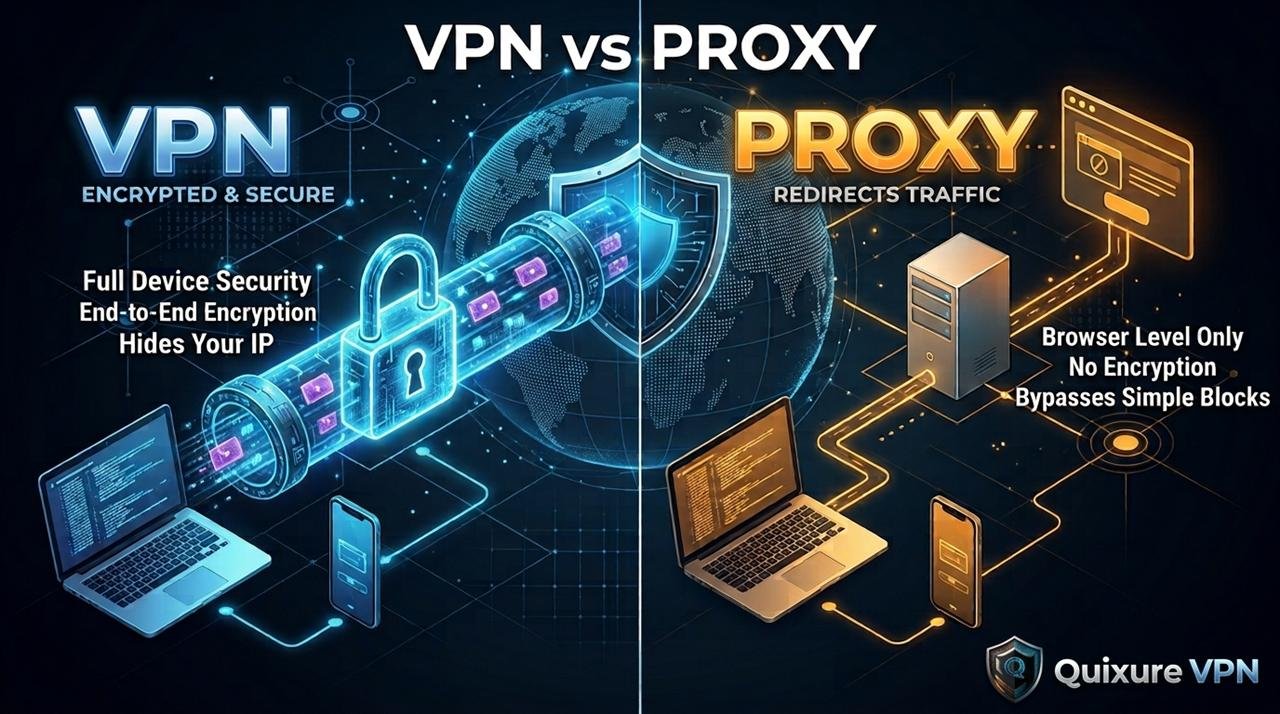
A proxy server sits between your device and the internet and forwards your requests on your behalf, so the website you're visiting sees the proxy's IP address instead of yours. Most proxies — the common HTTP and SOCKS types — work at the level of a single app or browser: you point that one app at the proxy, and only its traffic goes through it. Everything else on your device, from your email client to your operating system's own background traffic, continues on as normal, unaffected.
What Is a VPN?
A VPN also routes your traffic through a remote server and hides your real IP address, but it does so for your entire device at the operating-system level, not just one app. Quixure VPN also encrypts that traffic end-to-end using AES-256-GCM over WireGuard, the same approach covered in our guide to how VPNs work — so what's actually inside the traffic is unreadable to anyone between your device and the VPN server, not just hidden in terms of its source.
VPN vs Proxy: The Key Differences
- Encryption — A VPN encrypts your traffic. Most proxies don't encrypt anything; they just forward it, which means your data can still be visible to the proxy operator or to anyone on the network in between.
- Coverage — A VPN protects your whole device once connected. A proxy typically only covers the one app or browser you've configured to use it.
- Reliability — Free public proxies are often slow, unstable, or ad-supported, and you generally have no way to verify what the operator does with your traffic. A reputable VPN provider publishes a clear no-logs policy you can hold them to.
- Typical use case — Proxies are often used for quick, low-stakes tasks like checking how a site looks from another country. A VPN is built for anything where privacy and security actually matter: banking, public Wi-Fi, or just keeping your everyday browsing private.
Does a Proxy Protect Your Privacy?
Only partially, and not in the way most people assume. A proxy can hide your IP address from the specific site you're visiting through it, but since the connection usually isn't encrypted, your internet provider, the Wi-Fi network you're on, or the proxy operator itself can often still see exactly what you're doing. That's the opposite of what a VPN is for — on a VPN, that same traffic is encrypted, so even the network you're connected to only sees that you're talking to a VPN server, not what's inside that connection.
When Might a Proxy Be Enough?
To be fair to proxies, they're not pointless — for a narrow task like quickly viewing region-locked content in a browser with no sensitive data involved, a proxy can be a lightweight option precisely because it skips encryption overhead. Where it falls short is anything involving passwords, payments, personal messages, or an untrusted network like public Wi-Fi, where the lack of encryption and device-wide coverage actually matters.
Why Choose a VPN Over a Proxy?
Quixure VPN covers what a typical proxy doesn't: AES-256-GCM encryption over WireGuard on every connection, an automatic kill switch so nothing leaks if the tunnel drops, and DNS leak protection so even your lookups stay inside the encrypted tunnel. It runs on 10Gbps servers in 25+ countries under an independently audited zero-log policy backed by RAM-only infrastructure, and a single subscription covers unlimited simultaneous connections across Windows, Mac, iOS, Android, iPad, Linux, and the browser extension — your whole device, not just one browser tab. If you're already using a VPN for public Wi-Fi, the same protection applies here: one connection, covering everything.
Get Full-Device Protection, Not Just a Proxy
Quixure VPN encrypts everything leaving your device — not just one browser tab — with AES-256-GCM encryption, a kill switch, and DNS leak protection built in.
A proxy and a VPN can both change the IP address a website sees, but only one of them actually protects what's inside your traffic. For a quick, low-stakes task, a proxy might be enough. For anything where privacy or security actually matters, the encryption and device-wide coverage a VPN provides isn't optional — it's the whole point. You can download Quixure VPN in under a minute, or compare plans first.